


6 Ways Teachers are Improving STEM Education with 3D Scanning and Printing
by Matter & Form on June 13, 2019
While the term STEM (Science, Technology, Engineering, and Math) might bring to mind abstract visions of elaborate and futuristic high tech classrooms, there’s no need to be overwhelmed. There are practical ways to implement STEM learning into your curriculum right now. Read on to discover comprehensive, easy-to-follow lesson plans for improving STEM education in the classroom.
How 3D Printing and Scanning Support STEM Learning in the Classroom
3D printers and scanners are a no-hassle way of implementing and improving STEM education in the classroom.
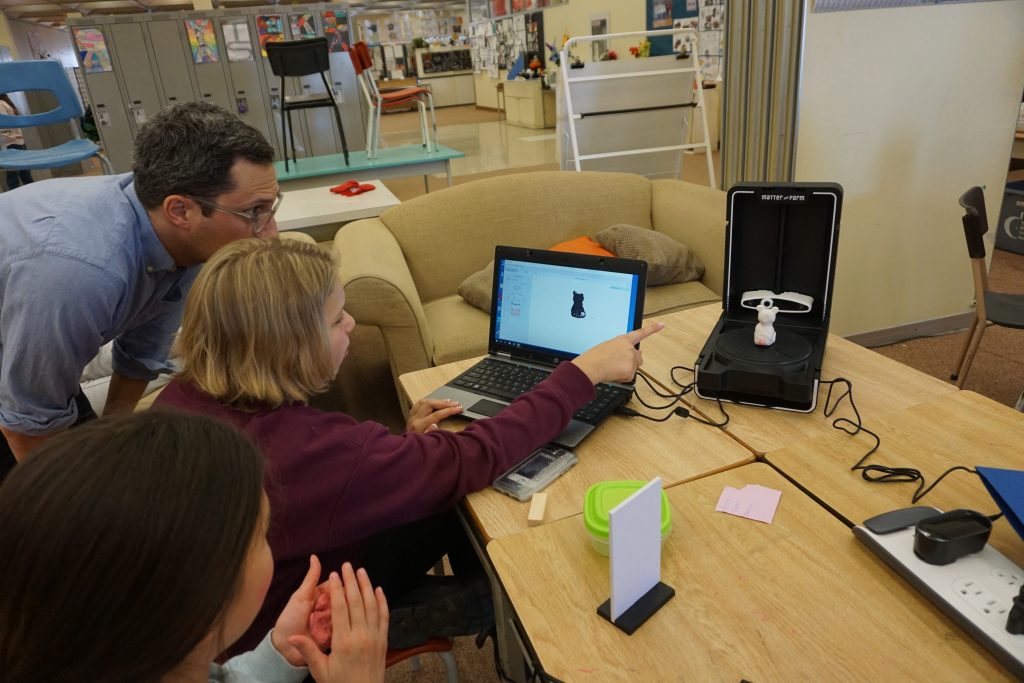
3D printing lets students materialize their ideas and produce complex, functional shapes by making solid 3D objects from a digital file.1 A 3D scanner scans an object to create a 3D digital model, which can then be used for artistic design, measurement, or 3D printing. Students can scan real-life objects, alter their measurements on a digital platform, and identify how scale affects the structure and performance.
A hands-on approach to education helps students better retain and comprehend the information they’re being taught. 3D scanning and 3D printing enable educators to better communicate the principles in subjects such as physics, engineering and math while maximizing engagement. The scanning process is iterative and requires students to experiment, analyze, and engage with computational thinking.
[cp_modal display=”inline” id=”cp_id_d4787″][/cp_modal]
Case Study: How 3D Printing Can Ease the Fear of Failure
Markus Hartnett undertook a 3D printing project with 200 fourth and fifth graders. In it, students built, revised, tested and gathered feedback on a prototype. The students’ mission was to “colonize a new planet” by creating clay designs and put them into 3D software. Markus stated that the results were very positive, “for [the students] to see their thoughts put into action, the expressions on their faces were incredible.” He also notes that “3D printing is a great tool to ease the fear of failure, as a student can design a prototype, see how it works and, if it fails, they can modify their design and print another one. Even engineers at the professional level have to deal with failure and adjustment.”2
6 Creative Lesson Plans for Improving STEM Education.
1. Communicate the Life Cycles of Stars
In our Burning Bright lesson, students can use qualitative modelling to:
- Develop a model based on evidence to illustrate the life span of the sun and the role of nuclear fusion in the sun’s core to release energy in the form of radiation.
- Communicate scientific ideas about the way stars, over their life cycle, produce elements.
- Use a computer simulation to model the impact of proposed solutions to a complex real-world problem with numerous criteria and constraints on interactions within and between systems relevant to the problem.
2. Create a Model of a Habitation for Survival on an Alien Planet
In our Lost in Space activity, students will apply knowledge of volume and surface area to:
- Use a computer simulation to model the impact of proposed solutions to a complex real-world problem with numerous criteria and constraints on interactions within and between systems relevant to the problem.
- Use geometric shapes, their measures, and their properties to describe objects.
- Define appropriate quantities for the purpose of descriptive modelling.
3. Explain Physical Properties of Matter
In our Properties of Matter lesson, students will use a 3D scanner to:
- Make observations and measurements to identify materials based on their properties.
- Make observations and measurements to produce data to serve as the basis for evidence for an explanation of a phenomenon.
4. Build a Model of Earth’s Plates
In our Art of Plate Tectonics lesson, students will model the processes that shape continental and ocean floor features to:
- Develop a model to illustrate how Earth’s internal and surface processes operate at different spatial and temporal scales to form continental and ocean-floor features.
- Develop a model based on evidence of Earth’s interior to describe the cycling of matter by thermal convection.
5. Illustrate the Evolutionary History of Humans
In our Secrets in Skulls lesson, students will use modelling, 3D scanning and printing to:
- Communicate scientific information that common ancestry and biological evolution are supported by multiple lines of empirical evidence.
- Construct an explanation based on evidence for how natural selection leads to the adaptation of populations.
- Evaluate the evidence supporting claims that changes in environmental conditions may result in (1) increases in the number of individuals of some species, (2) the emergence of new species over time, and (3) the extinction of other species.
- Use a computer simulation to model the impact of proposed solutions to a complex real-world problem with numerous criteria and constraints on interactions within and between systems relevant to the problem.
6. Explore Satire and Practice Writing
In our What Lies Beneath lesson, students will use project-based learning to:
- Analyze a case in which grasping a view requires distinguishing what is directly stated in a text from what is really meant.
- Determine the meaning of words and phrases as they are used in the text, including figurative and connotative meanings; analyze the cumulative impact of specific word choices on meaning and tone.
- Establish and maintain a formal style and objective tone while attending to the norms and conventions of the discipline in which they are writing.
- Compare and contrast findings presented in a text to those from other sources, noting when the findings support or contradict previous explanations and accounts.
Click here to access the complete lesson plans.

Implement STEM Learning into Your Curriculum with a 3D Scanner
With this technology, teachers can bring lessons to life in a new way that was previously inaccessible.3 Gone are the days when students could only print on traditional two-dimensional paper. 3D technology is an enriching teaching tool that promotes imagination, creation, engagement, and enables students to leverage their creativity and innovation within the world of design.
To find out more about STEM technology, and how 3D scanning is improving learning in the classroom, visit our blog or browse our website today.
Sources:
- 3D Printing.com, What is 3D Printing?
- American Society of Mechanical Engineers, 3D Printing Engages Students in STEM
- The Tech Advocate, How to Use 3D Printing in STEM Classes